Business reality
Small teams are complex enough to need operating discipline, but too small to carry specialist management infrastructure in every function.
Aument for stretched leadership teams
For businesses under 85 seats, leadership is often the fallback operating layer: the small group that spots opportunities, checks facts, ranks priorities, approves sensitive actions, holds context, and repairs broken work. Aument starts with one recurring workflow and turns that hidden leadership labour into source-backed, governed, measurable operating cadence.
Context first
The business does not need another system that creates output for leadership to review. The business needs fewer avoidable questions, clearer next moves, safer delegation, and proof that the workflow improved.
Small teams are complex enough to need operating discipline, but too small to carry specialist management infrastructure in every function.
Leadership becomes the integration point for revenue, operations, risk, approvals, strategy, and institutional memory.
Set up one governed loop: connect the facts, rank the work, route authority, create receipts, verify outcomes, and learn.
Returned leadership time can be used for strategy, experiments, alignment, relationships, hiring, and cleaner delivery of recurring work.
Leadership reality
These businesses are rarely short of ambition. They are short of coordinated capacity, technical management depth, and the operating substrate that lets work move without coming back to the same leadership bottleneck.
Leads, quotes, bookings, renewals, upsells, reviews, abandoned carts, pricing ideas, and partner opportunities are visible but not consistently actioned.
Status checks, reconciliations, customer replies, follow-ups, handoffs, troubleshooting, and exception routing consume management attention.
Policies, claims, refunds, compliance steps, tax items, customer promises, and sensitive outputs depend on memory and informal approval.
When context, evidence, authority, and tradeoffs are not encoded, routine decisions return to the most expensive and constrained people in the business.
Why agents alone do not solve it
The business probably already believes AI can draft, search, analyse, and suggest. The commercial problem is that a plausible answer can still be wrong, unsupported, stale, overconfident, unauthorised, impossible to verify, or disconnected from whether anything useful happened.
An answer can sound right while relying on stale, partial, unsupported, or misread facts.
A strong recommendation still needs source quality, policy, approval, risk class, and support-limit checks.
Sending, updating, or drafting does not prove the provider state, customer outcome, repair state, or business value.
A useful response does not create recurring cadence with receipts, outcomes, learning, and escalation.
Aument definition
A workflow is any repeatable place where evidence, decisions, actions, and outcomes meet: revenue follow-up, stay readiness, commerce readiness, reporting, refunds, support triage, compliance checks, delivery handoffs, or another area where leadership is still the fallback.
Connect sources, goals, constraints, roles, policies, current state, readiness gaps, and support limits.
Rank candidate moves by value, evidence, confidence, urgency, risk, timing, capacity, and strategy fit.
Separate recommend, draft, approve, act, abstain, block, escalate, and repair.
Create receipts, proof metrics, outcomes, reasons work was not used, and learning for the next cycle.
The operating loop
What makes it unique
| Layer | Business translation | Leadership benefit |
|---|---|---|
| Source-backed | Facts the business can inspect rather than unsupported AI output. | Leadership does not personally verify every fact before work moves. |
| Ranked | The next thing worth doing, not another brainstorm or longer backlog. | Capacity goes to the highest-value, best-supported moves. |
| Governed | Clear control over sensitive actions, approvals, privacy, spend, and evidence limits. | Leaders can delegate more without losing control. |
| Measurable | Receipts and proof that show whether the work was used and changed anything. | The business can continue, stop, or expand based on evidence. |
| Strategically aligned | Work selected against goals, constraints, risk appetite, timing, and capacity. | Urgent work is less likely to crowd out important work. |
| Repeatable | The same workflow improves each cycle instead of restarting from memory. | Operating leverage compounds rather than returning to leadership as a fresh problem. |
Business return
Find and rank commercial moves the business has evidence for but does not consistently pursue.
Convert repetitive admin-heavy work into source-backed queues, drafts, checks, and governed routines.
Make customer claims, compliance steps, refunds, spend, approvals, and external outputs controlled and auditable.
Separate genuinely leadership-only work from work that only returns to leadership because context and rules are missing.
First proof positioning
The operating-system story becomes credible after one loop proves value. The first proof should be narrow enough to inspect real sources, define authority, produce useful work, and measure whether leadership gets capacity back.
A recurring process that matters every week and keeps returning to leadership.
A person who can sponsor access, confirm facts, approve outputs, and judge proof.
Exports, read-only access, files, inboxes, policies, or systems sufficient for the first loop.
A 14–30 day signal tied to revenue motion, fewer touches, faster resolution, risk control, alignment, or capacity.
Reference workflow families
| Workflow family | Best current product posture | Boundary |
|---|---|---|
| Customer reply follow-up | Governed draft and manual-proof loop. | Email-send autopilot waits until provider-send authority and proof are bound. |
| Lead intake / quote follow-up | Ranked lead handling, next-action preparation, and draft-ready follow-up. | Bind CRM writes only where object scope, contract, approval, and verifier are proven. |
| Calendar coordination | Schedule preparation and approval flow. | Position provider writes as preparation unless final-state proof is ready. |
| Invoice / payment follow-up | Draft invoice, draft order, and approval-sensitive follow-up. | Finance/payment examples require approval and proof caveats. |
| CRM hygiene / revenue pipeline | Readiness diagnosis, ranked cleanup, and support-limited write preparation. | Broad write automation waits until source and executor posture are ready. |
| Risk / policy / compliance work | Evidence, approval, support-limit, and receipt structure. | Governed control is the claim; unsupported legal/compliance conclusions are not. |
Part Two: Product story
The product makes the loop concrete for the business: context, readiness, priority, authority, proof, and learning become visible in one governed system.
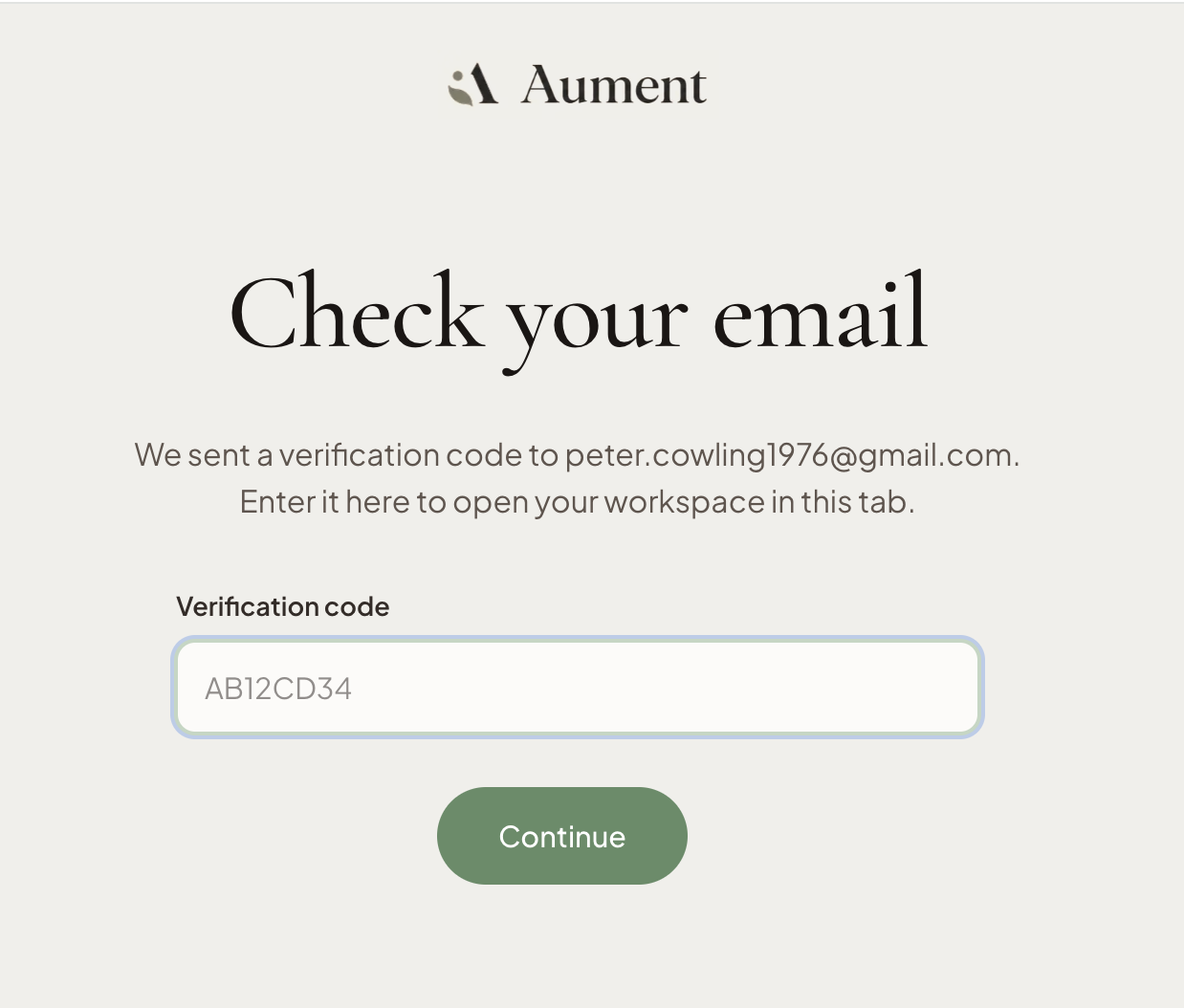
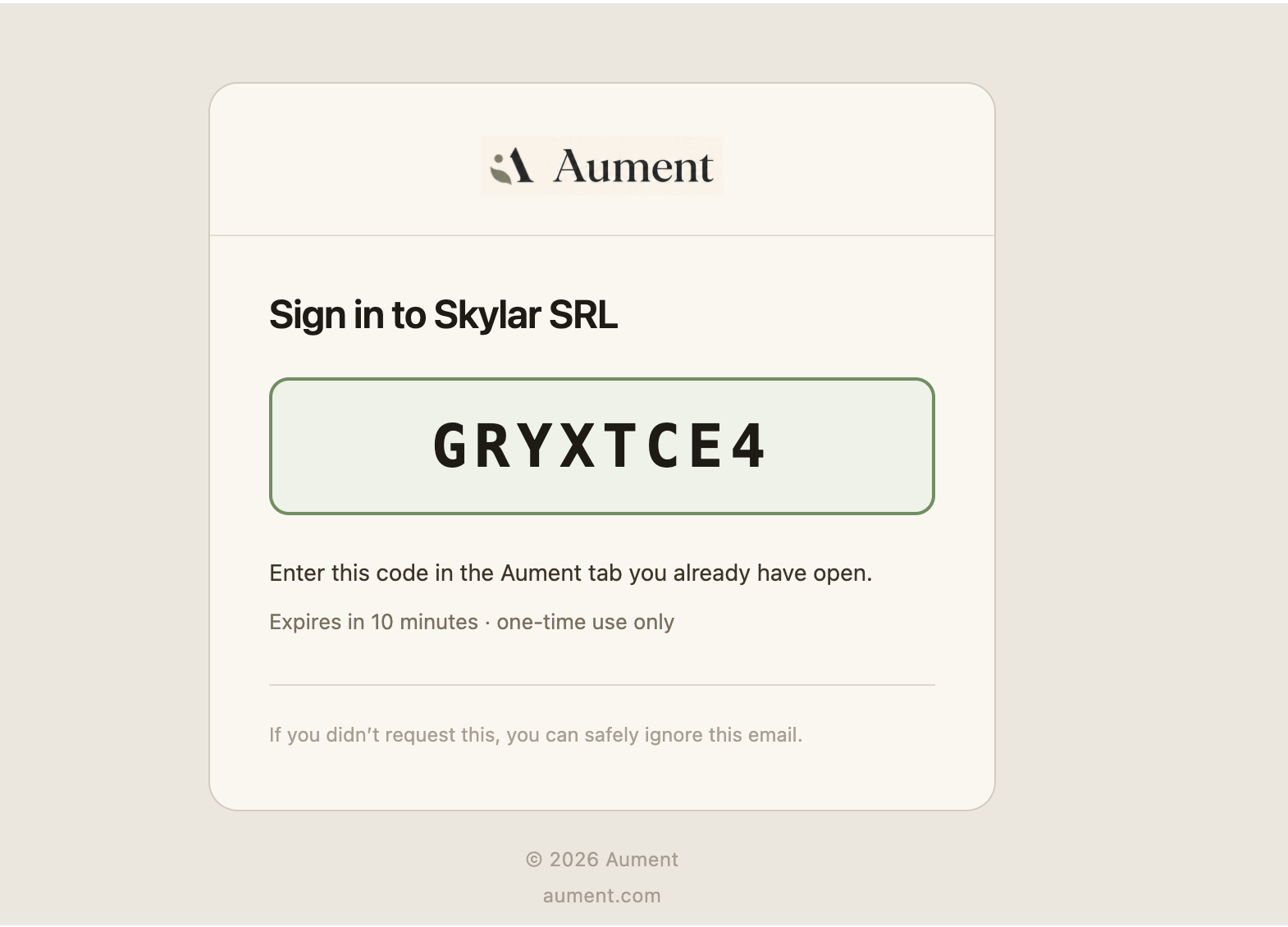
Safe workspace access
Before any workflow can be trusted, the business needs to see that workspace access, tenant context, and verification are treated as part of the operating system.
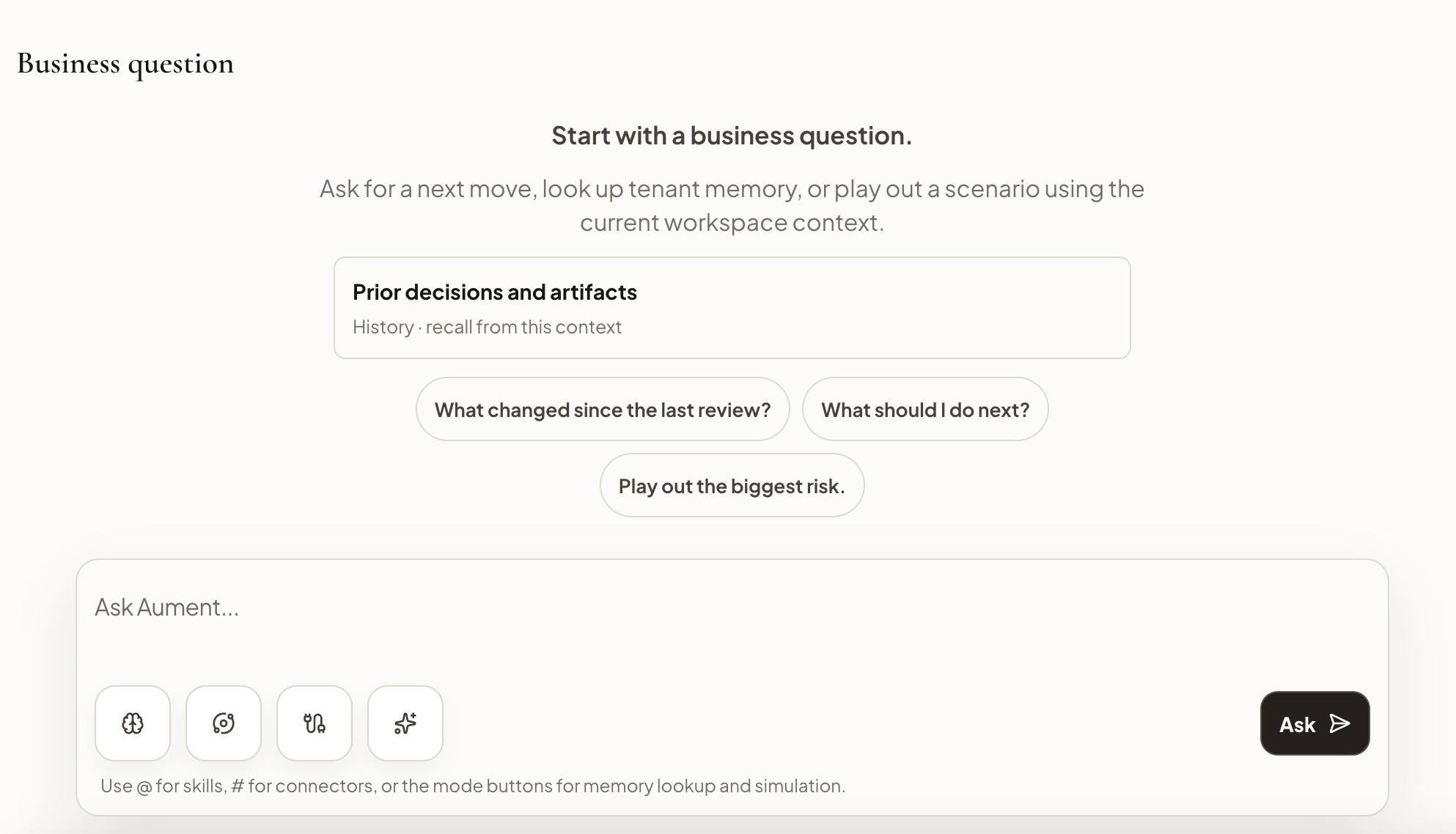
Ask Aument
The question box is not generic chat. It is the entry point for memory lookup, source-backed reasoning, scenario testing, connector-assisted work, and governed recommendations inside the current workspace context.
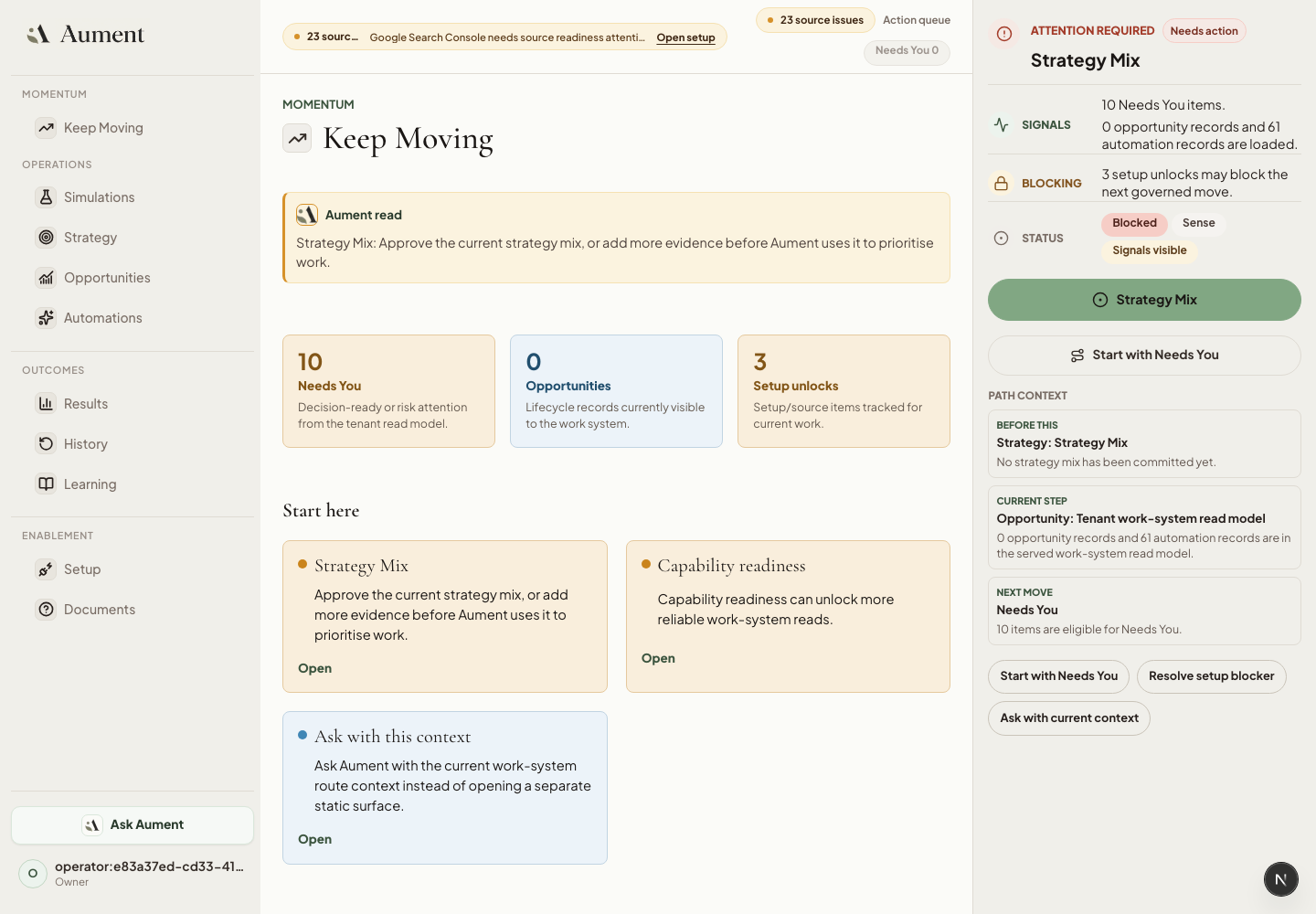
Keep Moving
In the authenticated workspace, leadership sees what needs attention, why it matters, what setup or source issue blocks progress, and which action lane is available next.
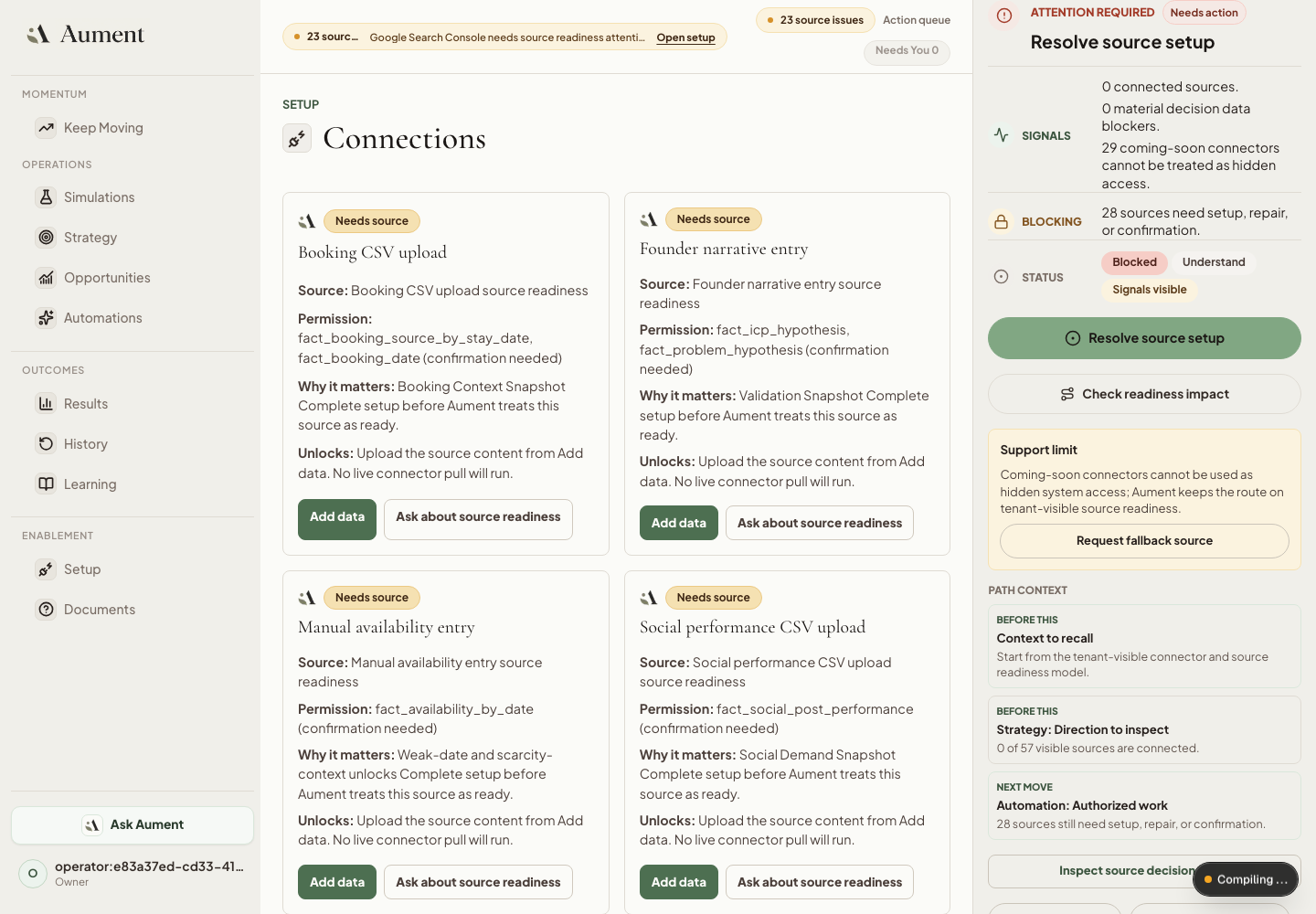
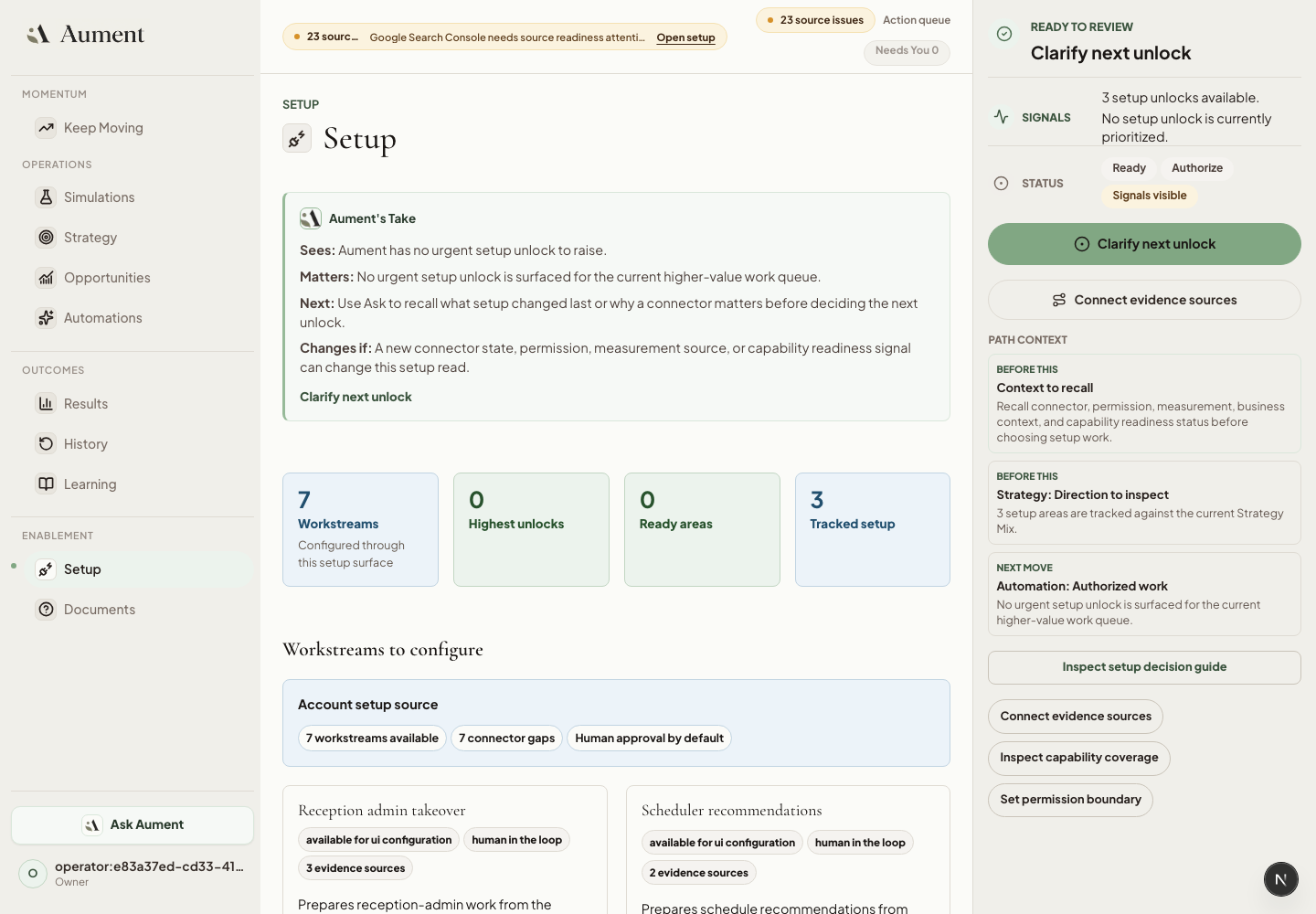
Source and setup readiness
The system does not treat every connector, file, or business fact as equally action-ready. It exposes source gaps, permission boundaries, setup unlocks, and support limits before the business relies on recommendations or external actions.
Governance states and action lanes
Every request can move through named states before the business trusts it: classify, check sources, choose mode, bind an action lane, route approval or block, verify, repair where supported, and measure the outcome.
Live source certification
Gmail message and thread reads can be described through object identity, pagination, freshness limits, reliability telemetry, source authority, and repair actions.
Stripe customer and invoice reads can be described through object identity, cursor pagination, freshness limits, reliability telemetry, source authority, and repair actions.
Strategy and simulation
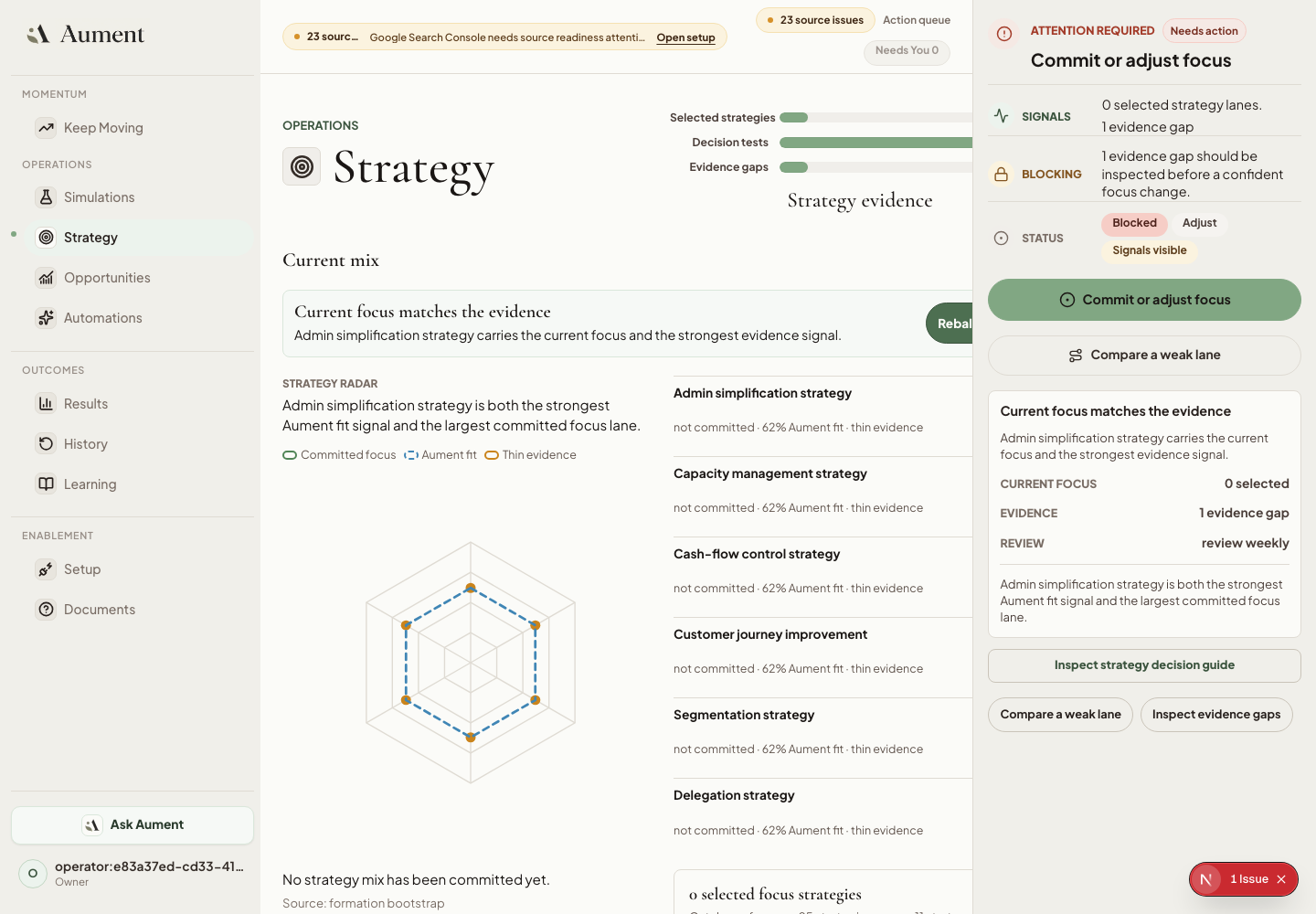
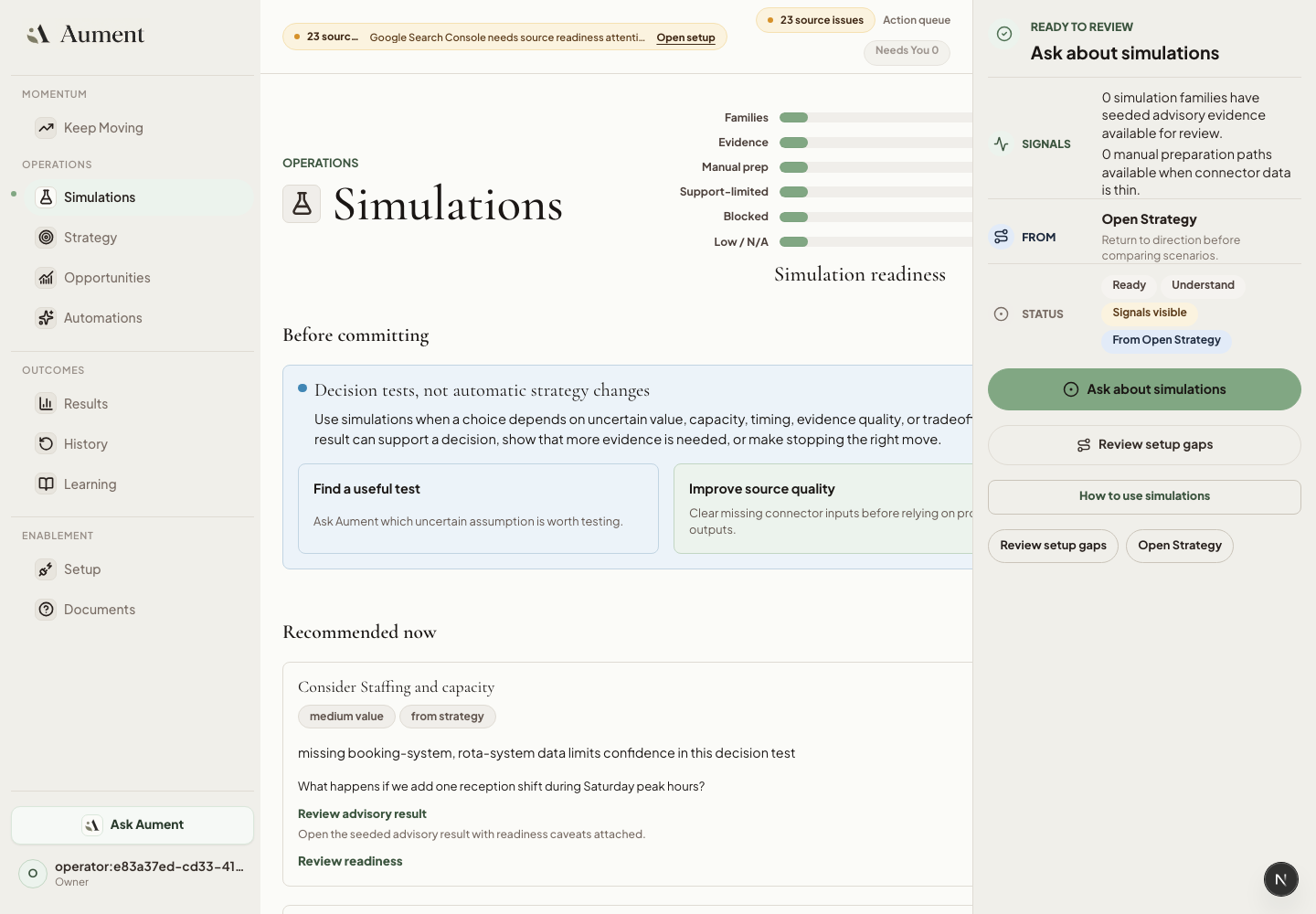
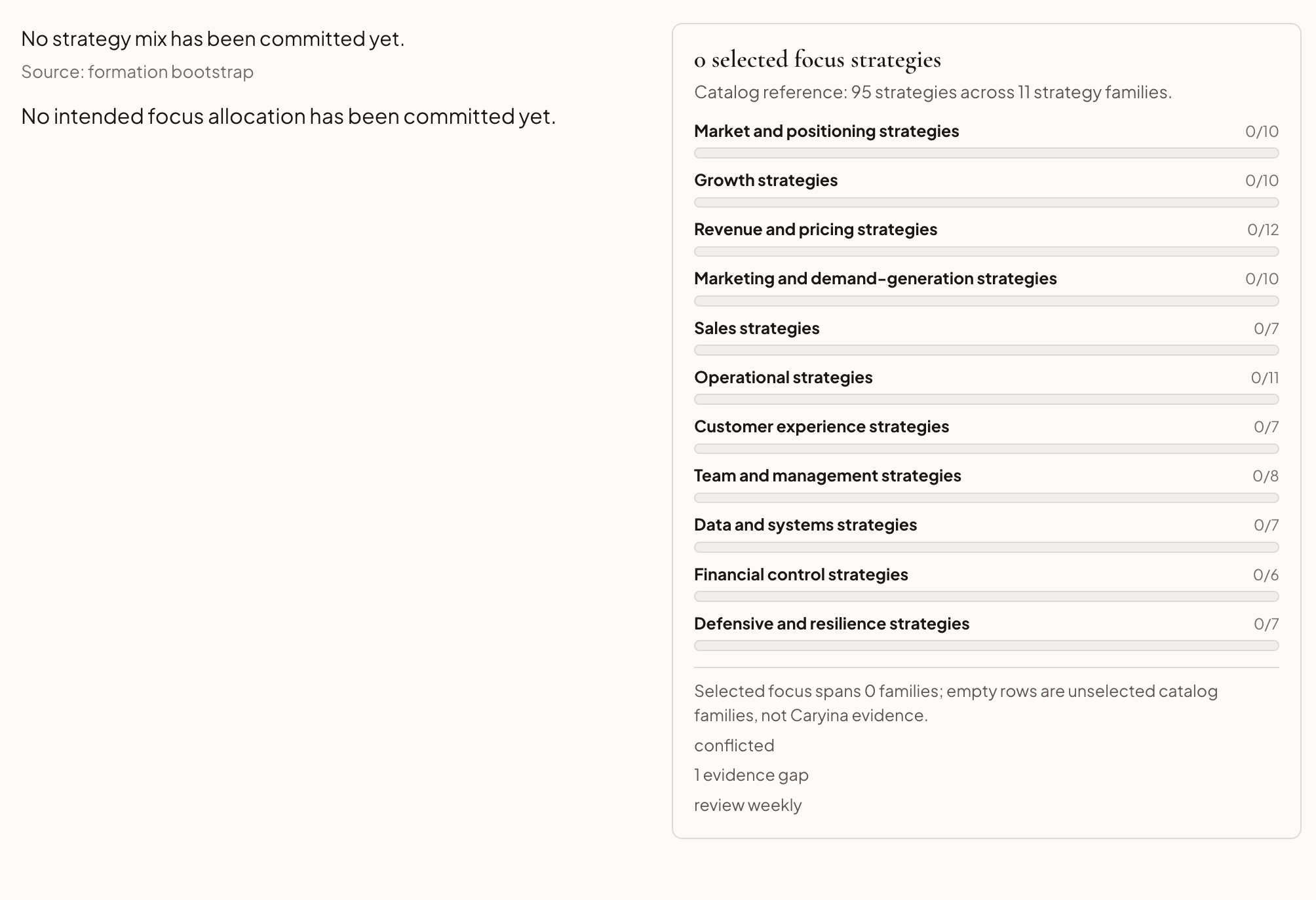
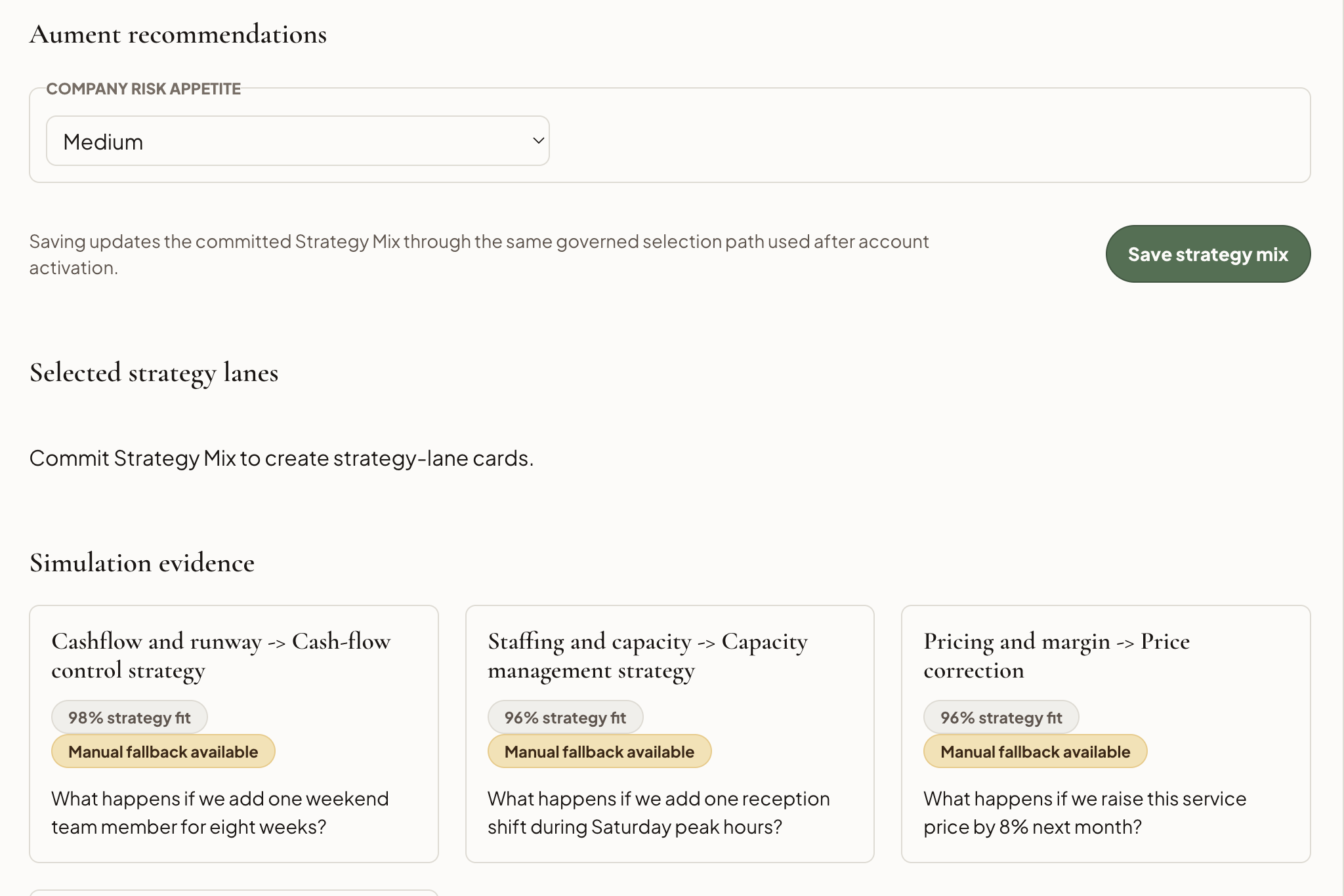
Strategy is not a separate workshop artifact. Aument exposes current focus, evidence gaps, decision prompts, and simulation paths where uncertainty, capacity, timing, or source quality should be tested before the business commits.
Strategy selection
The system can show strategy families, unselected focus areas, simulation evidence, appetite, fallback posture, and the governance path for saving a strategy mix.
Simulation to action
Execute or run a reversible pilot only when source quality, authority, verifier coverage, and repair posture are sufficient.
Route approval when evidence supports the move but authority still belongs with a human.
Request data, connect a source, or build capability when the decision is promising but the substrate is not ready.
Abstain when evidence challenges the action, the value of more information is low, or support limits are too strong.
Risk, documents, and proof artifacts
Reports and generated artifacts persist with revisions, selected workspace state, source boundaries, and admission checks.
Share groups, collaboration events, policy controls, and repair paths turn document access into governed state.
Tenant-safe risk projections can show residual severity, appetite breaches, stale reviews, evidence freshness, support limits, and mitigation refs.
Risk and document findings route back into Keep Moving, a decision brief, a simulation, approval, block, or escalation.
Results and proof
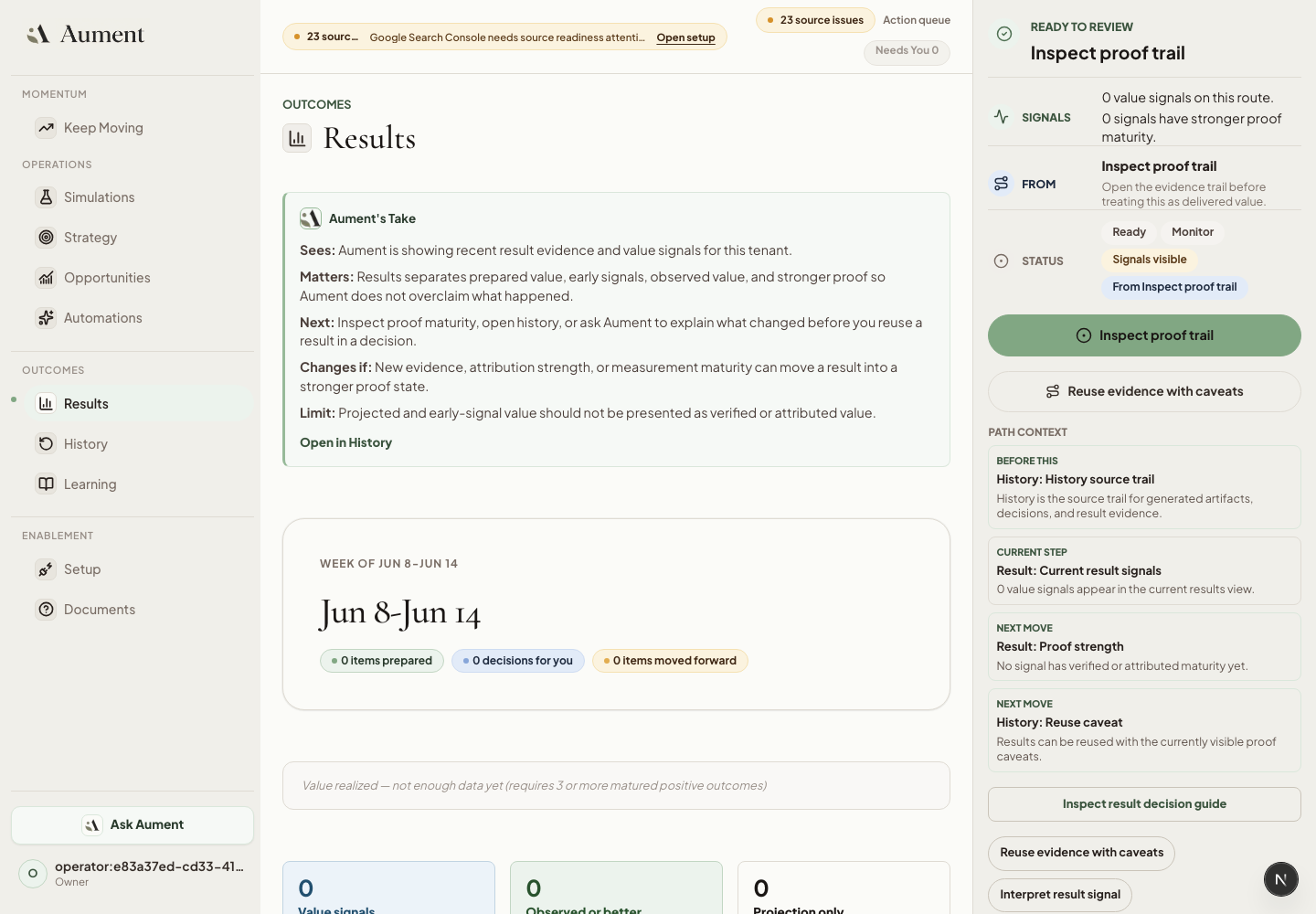
Aument separates prepared value, early signals, observed value, and stronger proof so the business does not overclaim what happened. Expansion should be based on evidence that a loop was useful, repeated, safe, and worth continuing.
Part Three: Adoption path
The adoption path mirrors the product narrative: the leadership constraint is clear, the most important return is named, one recurring workflow is chosen, authority is defined, and value is proven within a narrow window.
Starting frame
Aument is relevant when revenue opportunities go unworked, admin consumes management attention, risks are personally held by leadership, and decisions keep returning because the business lacks shared context. The first step is to choose one of those workflows and test whether a governed work loop improves it.
Generic agent automation.
The place where leadership is still acting as the operating system.
The recurring process that gives the team the most leverage if it stops coming back every week.
Ideal early customer
Readiness check
| Question | Strong answer | Weak answer |
|---|---|---|
| Which workflow matters every week? | A named workflow with repeated decisions, handoffs, risk, or revenue impact. | A vague desire to “use AI” or “automate things.” |
| Who is accountable? | A business sponsor or operator can sponsor access, approve outputs, and judge proof. | No accountable lead or authority to change the workflow. |
| Where do the facts live? | Systems, files, inboxes, policies, or exports can be inspected. | Everything lives in people’s heads or locked systems. |
| What is sensitive? | Claims, actions, customer contact, spend, refunds, or external outputs can be bounded. | No one knows what requires approval or what should be blocked. |
| What would prove value? | A 14–30 day signal tied to use, outcome, safety, speed, or leadership capacity. | No measurable output, no proof window, and no willingness to continue if it works. |
Evaluation path
First engagement model
Purpose: identify the highest-leverage workflow where leadership is filling the operating gap.
Output: bottleneck map, source-readiness map, authority map, top ranked action, support limits, and proof metric.
Purpose: test whether the loop is refreshed, reused, acted on, and measurable.
Output: recommendations, approval states, receipts, reasons work was not used, proof metrics, and product gaps.
Purpose: run the loop as part of the operating cadence.
Gate: sources, approvals, support limits, receipts, and launch gaps are ready or explicitly accepted within scope.
Inspect the workflow
“Let’s pull up the systems that show leads, customers, orders, bookings, quotes, support signals, and outcomes. We can see whether Aument can produce a weekly opportunity plan worth acting on.”
“Let’s choose one repetitive process that steals leader or manager time. We can inspect the facts, define readiness states, route exceptions, and measure whether the loop reduces touches.”
“Let’s pick one sensitive workflow where unsupported claims or actions would be costly. We can map evidence, approval rules, limits, and receipts before anything is shared or actioned.”
“Let’s list the decisions that still come back to you and choose the one where a governed loop would give you the most time and control back.”
Part Four: Evaluating skepticism
When the business asks “why not use an agent?” or “technology has never helped us,” those concerns show what the business needs to trust before Aument can move forward.
Will this reduce work, or create another system to manage?
Will leaders stay in charge of sensitive decisions?
Will the proof loop show value quickly enough to justify expansion?
Will customers, staff, and external outputs be protected from unsupported action?
Concern map
| What they say | What they may mean | What Aument proves |
|---|---|---|
| “Why not just use an agent?” | They think the category is generic AI output. | The comparison is not cleverness. The proof is operating reliability: sources, ranking, authority, receipts, and proof. |
| “Technology has never helped us.” | They have bought tools that created admin, low adoption, or stale dashboards. | The scar tissue is real: many tools create admin, low adoption, or stale dashboards. Aument starts as a contained proof loop around one painful workflow. |
| “This sounds like work.” | They fear implementation burden before payoff. | The first ask is intentionally small: one lead, one source set, one approval lane, one proof window. |
| “Our data is messy.” | They worry the system will fail or expose internal disorder. | Source readiness is part of the value: usable, missing, stale, conflicting, sensitive, or unsafe. |
| “Will my team use it?” | They have seen adoption fail when tools add steps. | Aument removes ambiguity, chasing, rewriting, and repeated questions from the chosen workflow. |
| “What if it makes a mistake?” | They fear liability, customer harm, or loss of control. | Action states are explicit: recommend, draft, approve, act, block, repair, escalate. |
| “What is the ROI?” | Leadership capacity feels soft unless tied to money, speed, risk, or time. | One proof metric is chosen before expansion and tied to the selected workflow. |
Agent concern
The wrong answer is “our AI is smarter.” The right answer is “agents are useful for individual tasks; Aument governs recurring business workflows.”
“You can use agents for individual tasks. The issue is not that agents are not smart enough. In a real workflow, the business needs to know which facts are reliable, what is unsupported, what needs approval, what actually happened, what failed or was repaired, and whether the result was worth repeating.”
Implementation, data, and adoption concerns
Many tools create dashboards and admin. Aument begins as one contained proof loop that must show value before expansion.
Messy sources are normal. Source readiness marks what is known, stale, missing, conflicting, sensitive, unsafe, or good enough for a bounded first loop.
The value is fewer repeated questions, clearer ownership, fewer ambiguous handoffs, less rewriting, and an artifact that fits an existing cadence.
“The test is not whether the technology looks impressive. The test is whether one recurring workflow stops coming back to leadership in the same painful way.”
Risk, security, and control
| Business fear | Governance proof | Plain-language line |
|---|---|---|
| Wrong customer message | Draft, review, approval states, support limits, and provider-send launch policy. | “Sensitive outputs do not leave the business just because the system can draft them.” |
| Unsupported claim | Evidence refs, stale facts, missing data, and blocked reasons. | “If the evidence does not support the claim, the loop flags or blocks it.” |
| Loss of authority | Authority map, approval lane, action class, and executor-binding state. | “Aument separates what can be suggested, drafted, prepared, actioned, blocked, or escalated.” |
| Data exposure | Scoped source set, read-only/export start, and sensitive data boundaries. | “We only need the sources required for the chosen workflow.” |
| No audit trail | Receipts, outcome refs, verifier result, repair state, approval state, and proof metric. | “The business can see what was recommended, approved, actioned, verified, repaired, or blocked, and why.” |
Governance boundaries
Business checklist
There is a named recurring workflow that matters every week and is painful enough to inspect.
Someone can approve access, define what is sensitive, and decide which actions require review.
The business agrees what success would look like and how quickly the first signal should appear.
Final framing
The best opportunity statement is simple: this workflow matters every week; the evidence is scattered; the next action is often unclear; some actions are sensitive; leadership is still the fallback; and Aument can test whether a governed work loop creates revenue, removes drag, reduces risk, or frees time for strategy and delivery.
Aument gives stretched businesses a way to grow without making leadership the only thing holding the business together.